There is one reason SHIN FITNESS provides basketball training as often as possible throughout the school holidays: for the children's future, we do not want to stop the momentum of their development.
Australia's long holidays should not mean a complete stop
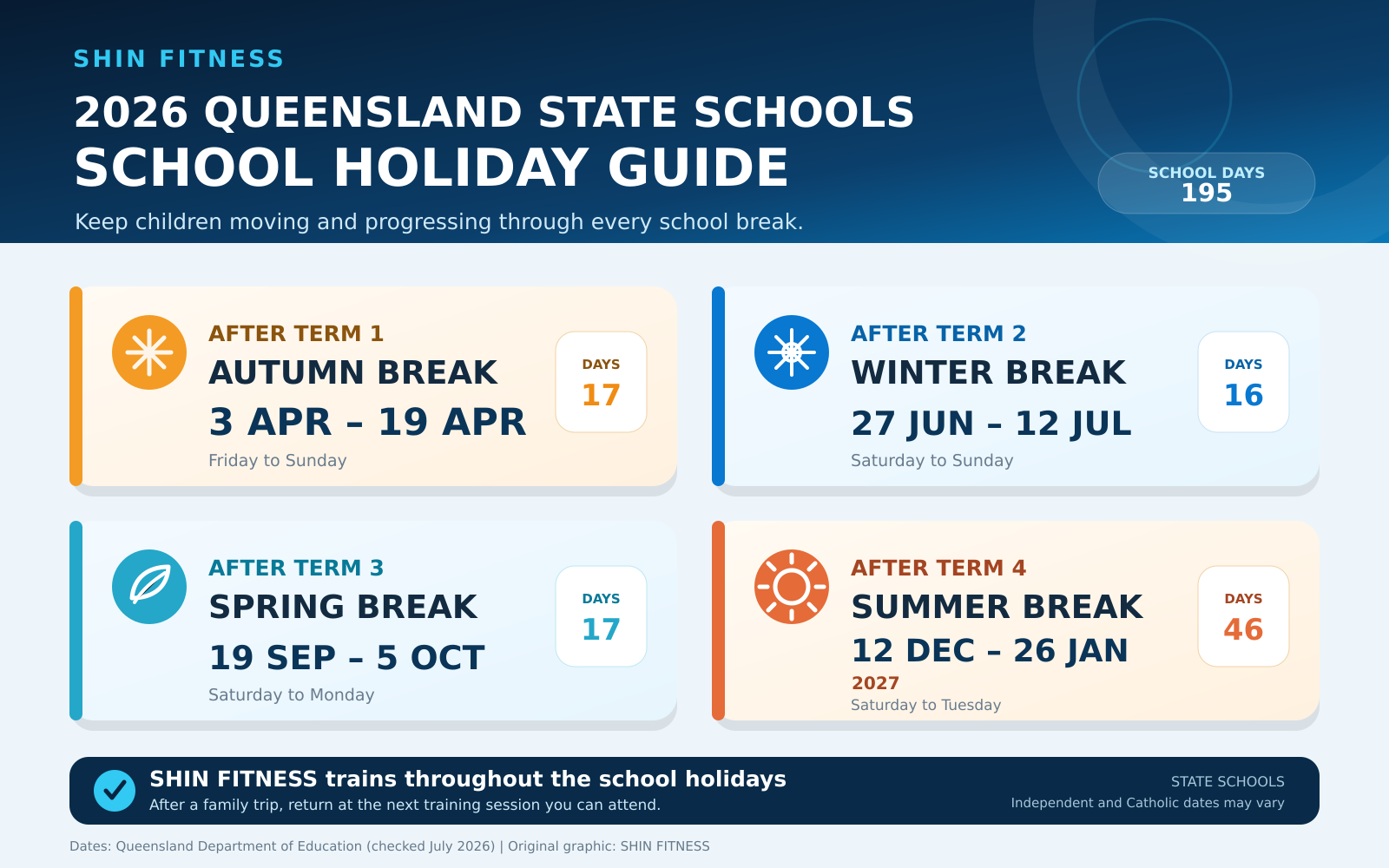
The 2026 Queensland state school calendar contains 195 school days. Between terms and over summer, children have four substantial holiday periods each year. Family time and travel are important. However, every holiday does not need to stop a child's physical activity, daily routine and training habits completely.
When children stay home today, it is easy for YouTube, iPads, phones and games to fill much of the day. Playing outside, running, jumping, throwing and competing with friends can disappear unless physical activity is deliberately placed in the schedule.
Source: Australian Bureau of Statistics, National Nutrition and Physical Activity Survey 2023, released June 2026. The guidelines used here are at least 60 minutes of physical activity per day for ages 5–17 and no more than two hours of sedentary recreational screen time.
Research also finds lower activity during school holidays
An Australian study that followed primary school children during the school year and summer holidays found that, during the holidays, moderate-to-vigorous physical activity fell by 12 minutes per day, sedentary time increased by 27 minutes, and screen time increased by 70 minutes. Another Australian study reported that body-fat percentage increased and aerobic fitness declined faster during the six-week summer holiday than during the school term.
Long-term data also deserve attention. An analysis of approximately 965,000 children and adolescents across 19 countries found that cardiorespiratory fitness declined by an average of 7.3% over the 33 years from 1981 to 2014. The pattern differed by country and period, and the international trend was broadly stable from around 2000. It would therefore be inaccurate to claim that every physical ability of every child today is dramatically worse than 30 years ago. Even so, both current statistics and research indicate that long periods of low physical activity work against the development of children's fitness.
What the research supports
Across groups, holidays can bring lower activity, more sedentary and screen time, and unfavourable changes in fitness or body composition. The effect of a short training break varies with the sport, age, baseline fitness and activity maintained during the break.
Nearly 10 years of SHIN FITNESS coaching experience
Players who take two or more weeks off with very little activity often need a long time to restore their fitness, movement speed, feel for the ball, decision-making, concentration and training routine.
Two weeks off can create a three-to-four-month detour
Over nearly 10 years, I have coached hundreds of children. One pattern I have seen repeatedly is that children who take a long break of two weeks or more and do almost no physical activity can return well below their pre-holiday condition.
In SHIN FITNESS coaching practice, some return at a level similar to where they were roughly two months before the holiday, then require another one or two months to regain their previous training condition. Including the ground that must be rebuilt, this can become a three-to-four-month detour.
The greatest loss is not only physical. When a child feels, “I cannot do what I could do before” or “my body will not respond”, motivation can fall. Repeatedly stopping, rebuilding and stopping again may also take away the opportunity to learn the value of consistency and experience the success that comes from small efforts accumulated over time.
Make training fees and time produce real development
If every holiday brings a long, complete stop and the following weeks are spent rebuilding the same basic fitness and skills, months of training are effectively used for recovery rather than progress. Paying fees alone does not develop a player. Consistent participation is what keeps the body, skills and habits connected.
Basketball cannot be fully learned alone
Basketball is a team sport. A player can practise shooting and dribbling alone, but spacing, passing timing, help defence, transition, communication and in-game decisions cannot be learned properly without teammates and opponents.
When 10 players attend, we can play 5-on-5. The content and quality of training are completely different when only a few players attend compared with 10 or more. Each child's attendance is not only for that individual; it helps create the training environment for every teammate.
Our strongest school-holiday attendance so far
This school holiday produced the best attendance SHIN FITNESS has recorded. We were able to play 5-on-5 almost every day and finally reached the training environment we had worked towards for a long time.
The children who attended almost every day showed clear improvement not only in skill, but also in fitness, decision speed, game understanding and connection with teammates. Some families travelled, returned after about one week, and joined training again immediately. That is an excellent example of balancing valuable family time with consistency in sport.
Thank you sincerely to every child who attended and every parent who continued to manage transport and family schedules.
What “training every day” really means
SHIN FITNESS is not trying to force every player to attend every day. Rest must be adjusted for age, game schedules, fatigue, injury and health. What matters is that we do not close the training environment simply because it is a holiday when a child wants to practise and improve.
That is why we provide training opportunities as often as possible during the school holidays and encourage members to aim for consistent participation three or more times per week.
- Avoid two or more weeks of complete inactivityTravel and rest are fine, but do not allow an inactive period to become unnecessarily long.
- Keep moving briefly while travellingWalking, light running, ball-handling or bodyweight exercises can be done within a safe and realistic range.
- Return at the next session you can attendDo not delay the return until “next week” or “when the school term starts”.
- Set limits for screens and protect sleepPlan physical activity, meals and sleep before allowing devices to fill the entire day.
- Treat team attendance as a responsibilityPlayers should learn that their attendance helps create 5-on-5 and higher-quality training for their teammates.
When a child is unwell, infectious, injured or heavily fatigued, rest and appropriate medical advice take priority over training. Consistency does not mean pushing through everything. It means avoiding repeated complete stops while building a routine that can be sustained long term.
What we are protecting is the children's future
Children grow every day, but simply getting older does not automatically build fitness, skill, resilience, concentration or responsibility. Those qualities develop through repeated practice, mistakes, cooperation and small improvements within a good environment.
A long school holiday can be spent almost entirely on YouTube, iPads and phones, or it can include movement, learning with teammates and building confidence. The difference may look small on one day, but over several years it can become substantial.
SHIN FITNESS will continue to be a place where children can keep developing throughout the year.
For Gold Coast players who genuinely want to improve
SHIN FITNESS coaches players aged 7–20, from beginners to club and representative athletes. We progressively develop skills, decision-making, fitness, discipline and concentration. Contact us about a trial, membership or private lesson.
References and evidence
- Queensland Government, 2026 School Calendar — Queensland state schools have 195 school days in 2026.
- Australian Bureau of Statistics, Children's physical activity, screen time and sleep — National Nutrition and Physical Activity Survey 2023, released June 2026.
- Australian Government, Recommendations for children and young people (5 to 17 years) — Recommends at least 60 minutes of moderate-to-vigorous activity and no more than two hours of recreational screen time per day.
- Watson A, et al. Children's activity and diet behaviours in the summer holidays versus school year. Pediatric Obesity. 2023.
- Olds T, et al. Changes in fitness and fatness in Australian schoolchildren during the summer holidays. BMC Public Health. 2023.
- Eglitis E, et al. Health effects of children's summer holiday programs: a systematic review and meta-analysis. IJBNPA. 2024.
- Tomkinson GR, et al. Temporal trends in the cardiorespiratory fitness of children and adolescents in 19 countries, 1981–2014. BJSM. 2019.
- Joo CH. The effects of short term detraining and retraining on physical fitness in elite soccer players. PLOS ONE. 2018.
- Gavanda S, et al. Three Weeks of Detraining Does Not Decrease Muscle Thickness, Strength or Sport Performance in Adolescent Athletes. IJES. 2020.
Research findings describe average group trends and do not mean that every child will experience the same change. The recovery and setback periods described from SHIN FITNESS are coaching estimates based on day-to-day observation.